1. Routes and delivery schedules
Define service areas, delivery rounds, stop sequences, time windows and recurring schedules.
I build logistics and delivery software around your operation, connecting orders, routes, vehicles, stock, delivery records and customer updates. My experience includes developing a Laravel delivery platform managing more than 3,800 active doorstep deliveries.
I develop bespoke logistics and delivery software around the processes that keep deliveries moving. My experience includes a Laravel-based dairy delivery platform managing more than 3,800 active doorstep deliveries.
Delivery operations connect orders, stock, routes, vehicles, staff, customer records, payments and reporting. A bespoke delivery management system can bring these workflows together, giving the people planning deliveries and handling them in the field a more consistent view of the operation.
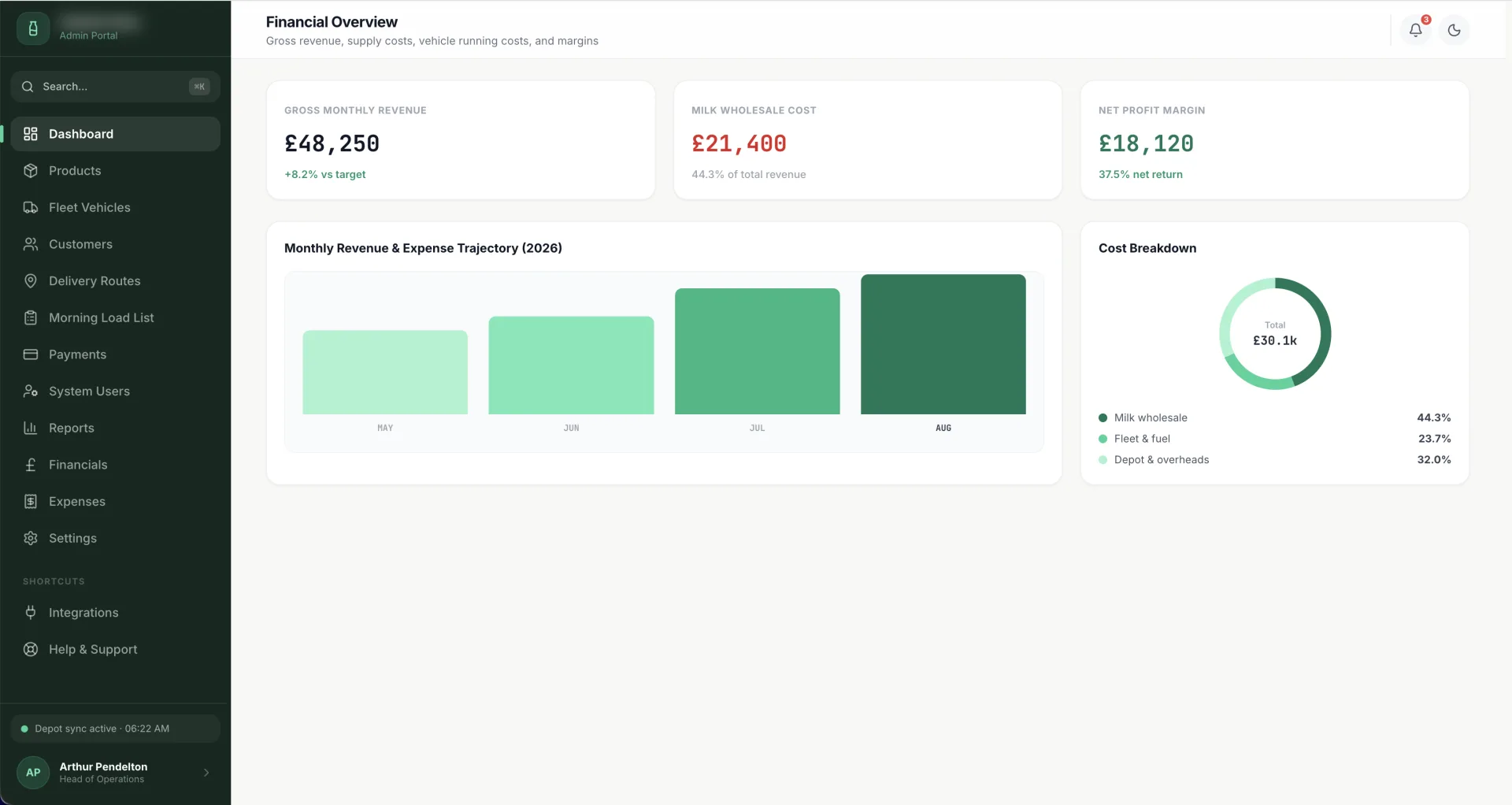
The dairy delivery platform I developed brings together delivery management and wider business processes, including route planning, fleet compliance, inventory and margin management, recurring payments, automated SMS notifications, reporting and financial management. It provides a practical example of how operational software can support more than the delivery itself.
For a new project, I start with your delivery model and the problems you need to solve. That might involve recurring delivery rounds, courier workflows, fleet coordination, customer amendments, stock allocation or a connection between existing order and delivery systems. The required features depend on the operation rather than a fixed package.
I can develop a focused application or connect delivery workflows to existing inventory, payment, customer or accounting software where suitable integration methods are available. I also consider exception handling, data ownership and reporting so that the system remains useful when orders change, deliveries fail or external services are unavailable.
Where route optimisation is required, I establish the constraints and data available before deciding how it should be implemented. The right approach depends on factors such as delivery windows, vehicle capacity, service areas, recurring stops and whether an external routing service is appropriate.
Delivery operations depend on accurate coordination between orders, routes, drivers, vehicles, stock and customer requirements. When these records are spread across spreadsheets and disconnected systems, it becomes harder to plan workloads, handle changes and understand what has happened on each delivery.
I develop bespoke logistics software around the way your business receives orders, prepares deliveries, assigns work and records completion. The application can connect the information needed by office staff, drivers and managers without forcing every part of the operation into a generic courier workflow.
I have practical experience in this area through a Laravel delivery platform built for a local dairy, managing more than 3,800 active doorstep deliveries. The system brings together delivery operations and related business workflows, including route planning, inventory, fleet compliance, recurring payments, notifications and reporting.
The right solution depends on what you deliver and how your operation runs. A recurring doorstep delivery service has different requirements from a courier business, a distributor or a company coordinating its own fleet. I establish those requirements before deciding which features and integrations are needed.
A custom delivery management system can bring together the operational stages between receiving an order and confirming that the delivery has been completed.
I define the route constraints, data ownership and exception-handling rules first, so dispatchers, drivers and office staff have a consistent view of what is happening.
The value of a delivery system depends on how accurately it reflects the rules that affect planning, fulfilment and communication.
Define service areas, delivery rounds, stop sequences, time windows and recurring schedules.
Connect delivery requirements to order quantities, available stock, substitutions and loading or preparation processes.
Manage driver assignments, vehicle availability, relevant records and the information needed to prepare each delivery round.
Record successful deliveries, failed attempts, customer instructions, discrepancies and follow-up actions.
Determine when customers should receive confirmations, reminders, changes or delivery-related notifications.
Identify the operational measures you need and the other systems that exchange delivery, payment or customer data.
A useful system needs to handle the exceptions that occur in real delivery operations, not just display a list of scheduled stops.
| Question to ask | A surface answer | A useful project answer |
|---|---|---|
| How are delivery routes planned? | Group stops by area. | Define route inputs, delivery windows, capacity, service constraints and whether route optimisation is required. |
| Can the system support recurring deliveries? | Create a repeated order. | Manage recurring schedules, customer changes, skipped deliveries and changes to future orders. |
| What happens after a failed delivery? | Mark it as undelivered. | Record the reason, update the relevant people and define whether to retry, reschedule or take another action. |
| How are route changes communicated? | Update the dispatch screen. | Keep the relevant driver, office staff and customers informed when their plans are affected. |
| How is stock linked to deliveries? | Record quantities on an order. | Define stock allocation, movements, shortages, substitutions and reconciliation against completed deliveries. |
| Can drivers update delivery records? | Allow access to a job list. | Provide an appropriate mobile workflow for delivery status, notes, exceptions and any required evidence. |
| Can the system connect to existing software? | Add an API integration. | Identify the systems involved, record ownership, synchronisation rules and handling of failed updates. |
| What can management report on? | Count completed deliveries. | Define useful measures for delivery volumes, exceptions, route performance, stock discrepancies and operational costs. |
A standard courier or delivery platform may be the best option if its existing features match your operation. It can provide established functionality without the cost and responsibility of developing a separate application.
Bespoke delivery management software is worth considering when your business has specialised requirements, such as recurring doorstep deliveries, customer-specific order rules, stock coordination or operational processes that standard products do not support adequately.
I can help assess the gaps before recommending a build. The answer might be a focused custom application, an integration between existing systems or a wider platform that connects delivery operations with the rest of the business.
Delivery tracking is only one part of the operation. Dispatch, stock preparation, fleet records, customer changes, payments and reporting also need clear ownership if the business is to work from reliable information.
My experience includes developing a Laravel delivery platform that manages more than 3,800 active doorstep deliveries. The project includes connected operational workflows, giving me practical experience of the challenges involved in coordinating delivery activity and the wider business processes around it.
I can map your existing processes, identify the most important problems and establish a development scope around them. Depending on your requirements, that could mean improving delivery scheduling, connecting inventory and customer records or developing a more comprehensive logistics management system.
You do not need a complete technical specification. I can map out your delivery workflows, identify where information or processes break down, and plan a practical system around your routes, stock, drivers and customers.
I can connect the people planning each route with the teams handling stock, payments and customer communication, giving the business a clearer picture of delivery activity.
I start by understanding the work the system needs to support. I keep decisions clear as the project moves from initial planning into development and launch.
I map the users, information, hand-offs and problems the software needs to solve.
I define the core features, data, integrations and a realistic first release with you.
I develop and test the application, then review it against real tasks and your feedback.
I help get the system live and plan sensible improvements as your requirements evolve.
A Laravel delivery management platform supporting more than 3,800 active doorstep deliveries, with connected route planning, inventory, fleet and financial workflows.
Answers to common questions about bespoke logistics software, delivery management, route workflows and operational integrations.
Verified client reviews on PeoplePerHour. Let’s make your project the next one.